🔥 Radiation in Participating Media (P1 Model)
Evaluate radiative heat flux in absorbing, emitting, and scattering semitransparent gray media using P1 differential spherical harmonics and Rosseland diffusion conductivity.
⚡ Fortran 90 Engine
Double Precision (IEEE 754)
✓ ISO / ASME Validated
 Radiation
📊 Solver Telemetry
● ACTIVE
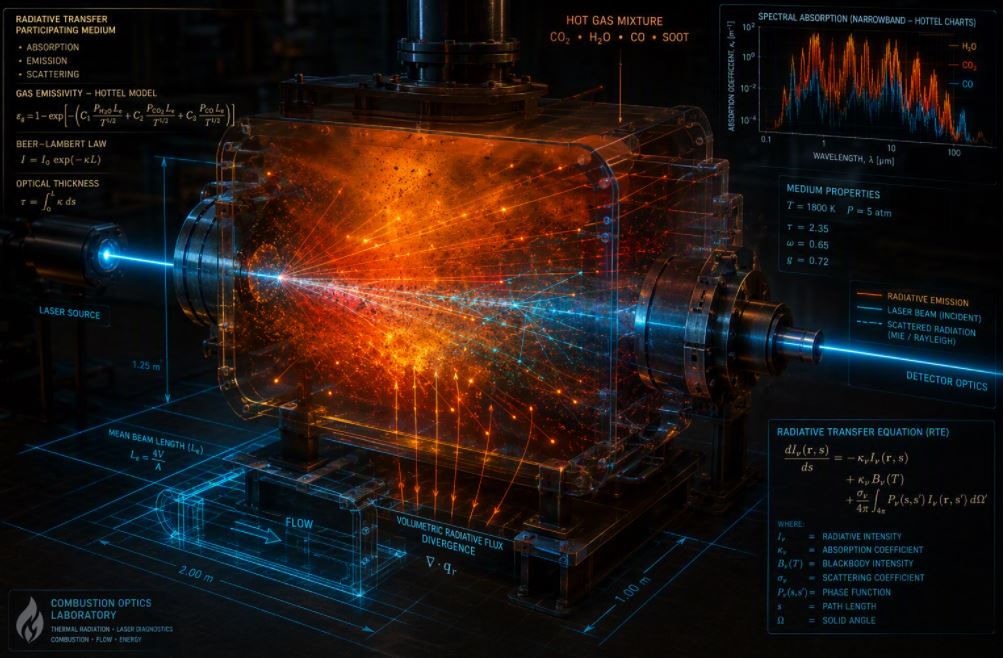
🔥 Participating Semitransparent Medium & Photon Scattering Field
Real-time visual simulation of photon emission, volumetric gas absorption & isotropic scattering attenuation📝 Configuration & Presets
P1 Spherical Harmonics Formulation:
• Extinction Coeff: β = a + σs | Optical Thickness: τ₀ = β · L
• P1 Heat Flux: qr = σ (T₁⁴ − T₂⁴) / [ (1/ε₁ − ½) + (1/ε₂ − ½) + ¾ τ₀ ]
• Rosseland Diffusion: krad = 16 σ Tmean³ / (3 β) [W/(m·K)]
• Scattering Albedo: ω = σs / β
• Extinction Coeff: β = a + σs | Optical Thickness: τ₀ = β · L
• P1 Heat Flux: qr = σ (T₁⁴ − T₂⁴) / [ (1/ε₁ − ½) + (1/ε₂ − ½) + ¾ τ₀ ]
• Rosseland Diffusion: krad = 16 σ Tmean³ / (3 β) [W/(m·K)]
• Scattering Albedo: ω = σs / β
📊 Radiative Flux Results
Configure inputs and click Compute to view results.
📘 Calculation Methodology & P1 Spherical Harmonics Standards
P1 Differential Approximation
The P1 method expands the directional radiative intensity into spherical harmonics, converting the complex integro-differential RTE into an elliptic Helmholtz equation:
∇²G − 3aβ G = −12aβ σ T⁴
Rosseland Diffusion Analogy
In optically thick media ($\tau_0 \ge 3$), radiation acts like pure non-linear heat conduction with equivalent radiative conductivity $k_{rad} = \frac{16\sigma T^3}{3\beta}$.
Key Engineering Assumptions
- 1D planar participating medium slab.
- Gray gas with wavelength-independent absorption and isotropic scattering.
- Opaque diffuse gray wall boundaries ($\epsilon_1, \epsilon_2$).